
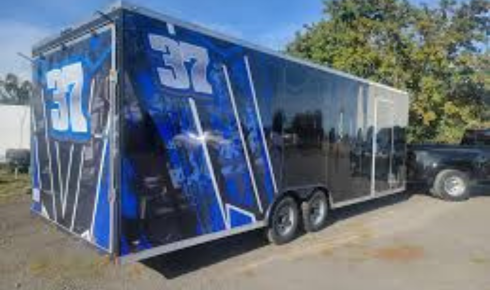
You don’t usually expect much from a trailer. It’s there to carry things, to sit quietly behind a truck, to do its job without drawing attention. But every now and then, one rolls past that makes you pause — not dramatically, just enough to notice.
A color that feels intentional. A message that’s easy to read without trying. Something about it just works.
And that’s when you realize… this isn’t just a trailer anymore.
When a Blank Surface Becomes a Canvas
There’s something uniquely powerful about a large, uninterrupted surface. It gives you room to breathe, to think, to create something that doesn’t feel cramped or rushed.
That’s exactly why full trailer wraps have gained so much traction. They allow businesses to use the entire trailer as a unified space — not bits and pieces, but one cohesive visual story.
When done right, it doesn’t feel like a design placed on top of a vehicle. It feels like the trailer was built that way from the start. Colors flow naturally, elements align seamlessly, and the message comes across without effort.
But here’s the thing — more space doesn’t mean more content. In fact, the best full wraps often say less, just more clearly.
The Quiet Strength of Doing Less
Not every idea needs a full canvas. Sometimes, restraint tells a stronger story.
That’s where partial trailer wraps come in. Instead of covering everything, they focus on key areas — maybe a bold graphic on one side, a clean logo placement, or a striking color accent.
It’s a bit like leaving white space in a design. It gives the eye a place to rest. It makes what’s there feel more intentional.
And practically speaking, it’s often a smarter entry point. Lower cost, quicker turnaround, and still plenty of visual impact. For many businesses, it’s not about going all-in immediately — it’s about starting with something that feels right.
The Material That Holds It All Together
Behind every wrap, there’s a layer most people don’t think about — the material itself.
Vinyl trailer wraps have become the standard for a reason. They’re flexible enough to adapt to different surfaces, durable enough to handle long hours on the road, and versatile enough to support a range of finishes.
But beyond that, they offer something else: reversibility.
You’re not committing forever. If branding changes, if the design needs a refresh, the wrap can be removed without damaging what’s underneath. It gives businesses a kind of creative freedom that traditional paint simply doesn’t.
Designing for the Way People Actually See
Here’s something that’s easy to overlook — most people don’t view trailer wraps up close. They see them from a distance, often in motion, sometimes for just a few seconds.
That changes how design works.
Text needs to be readable at a glance. Graphics need to be bold enough to hold their shape from afar. Colors need to stand out in different lighting conditions — bright sunlight, cloudy skies, even dusk.
It’s not about adding detail. It’s about choosing the right details.
And when everything aligns, the design feels effortless. Like it was always meant to be seen that way.
More Than Just Visibility
While the visual impact is obvious, there’s another layer that’s easy to miss: protection.
Trailers spend most of their time exposed to the elements. Sun, dust, road debris — over time, it all takes a toll. A wrap acts as a barrier, absorbing that wear instead of the trailer itself.
It’s not the primary reason people choose wraps, but it’s one of those benefits that quietly adds value over time.
A Different Kind of Marketing Pace
Most marketing today feels fast — quick campaigns, short attention spans, constant updates. Trailer wraps don’t really fit into that rhythm.
They’re slower. More consistent.
Once they’re out there, they keep working. Day after day, mile after mile. No need to tweak or optimize. No sudden drop in performance. Just steady, ongoing visibility.
And in a way, that reliability feels refreshing.
The Human Side of the Road
Behind every trailer is a business, and behind every business are people trying to build something — sometimes from scratch, sometimes against the odds.
Wrapping a trailer is a small part of that journey. It’s a way of showing up, of being seen, of saying, “We’re here, and this is what we do.”
And over time, those small moments of visibility add up.
Closing Thoughts
We don’t always notice the things that influence us. The designs we pass by, the names that become familiar, the visuals that quietly stick in our minds.
Trailer wraps live in that space — subtle, consistent, present.
They don’t need to shout. They just need to show up, again and again, until being seen turns into being remembered.

